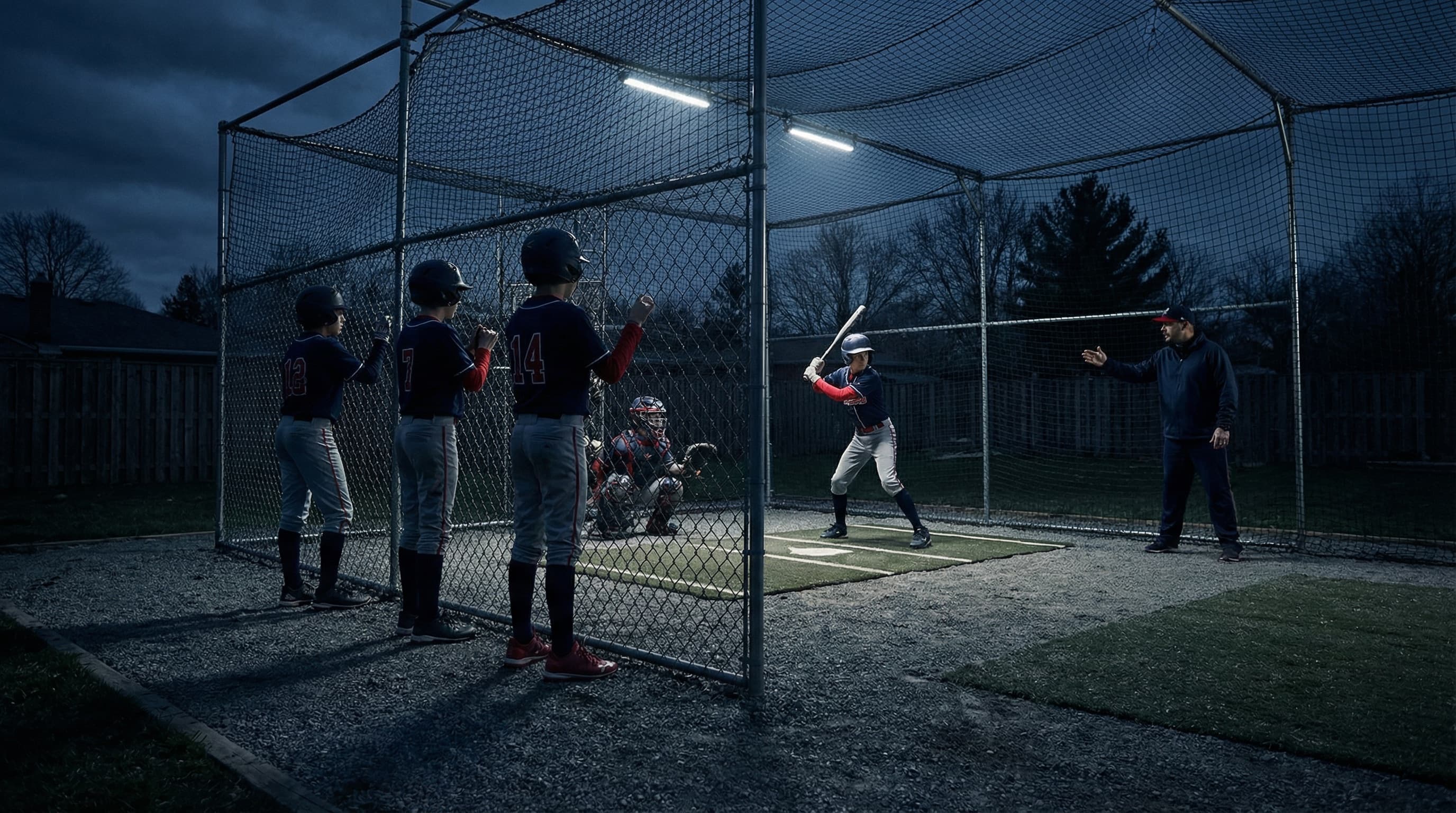
The right bat is the one a player can swing on time and control through the zone — not the biggest or heaviest one on the rack. This guide gives you a sizing chart by age and height, explains bat drop and league rules in plain English, and shows you a 10-second test to confirm the fit before you buy.
Bat sizing chart by age & height
Use this as your starting point for length, then confirm the weight with the feel test below. Height and strength matter more than age alone.
| Age | Height | Bat length |
|---|---|---|
| 3–4 (tee ball) | 3'0"–3'4" | 24–26 in |
| 5–6 | 3'4"–3'10" | 25–27 in |
| 7–8 | 3'10"–4'2" | 26–28 in |
| 9–10 | 4'2"–4'8" | 28–29 in |
| 11–12 | 4'8"–5'2" | 30–31 in |
| 13–14 | 5'2"–5'8" | 31–32 in |
| 15–16 | 5'8"–6'0" | 32–33 in |
| 17+ | 6'0"+ | 33–34 in |
Sizing is a guide, not a rule. Always confirm the certification your league requires (see below) before buying.
The 10-second feel test
A chart gets you a length; the feel test gets you the weight. Have the player hold the bat straight out to the side with one hand, arm fully extended. If they can hold it steady for 20–30 seconds and finish a full swing balanced, the weight is right. If the barrel dips or the swing feels like a drag, size down. Bat speed beats bat mass for nearly every hitter.
Understanding bat drop (length-to-weight)
Bat drop is the length in inches minus the weight in ounces, written as a negative number — a 30"/20 oz bat is a −10. A bigger drop is lighter and easier to swing; a smaller drop is heavier. Here's the typical drop by level:
Tee ball
−12 to −13As light as possible so a young hitter can control the barrel.
Youth (ages 7–12)
−10 to −12Bat speed matters more than mass — err lighter, not heavier.
Junior high (13–14)
−5 to −10Transition years; move toward a −5/−8 before high school BBCOR.
High school & college
−3 (BBCOR required)BBCOR .50 certified, −3 only. No exceptions in sanctioned play.
Fastpitch softball
−8 to −13Most players land at −10 to −12; confirm your league's rule.
League rules: USA, USSSA, BBCOR & fastpitch
The right size is useless if the bat isn't legal for your league. Match the stamp on the bat to your league's required standard:
USA Baseball (USABat)
Little League, PONY, Cal Ripken, most youth rec
Look for the USA Baseball stamp. Usually a 2 5/8" barrel with a range of drops. This is the most common youth standard today.
USSSA (1.15 BPF)
Travel / select youth ball
Look for the USSSA 1.15 BPF stamp. Allows bigger drops (−5, −8, −10) and 2 5/8" or 2 3/4" barrels — a hotter bat than USABat.
BBCOR (.50)
High school & college
Required for sanctioned play. −3 drop, 2 5/8" barrel, BBCOR .50 certification stamp. Performance is capped to mimic wood.
Fastpitch softball
Youth through college softball
Certified for your league (ASA/USA Softball, USSSA, NSA). Barrels are typically 2 1/4"; length and drop vary by age.
Common bat-sizing mistakes
- Buying too heavy for "more power." A bat you can't whip through the zone kills bat speed and drops your barrel — a lighter bat you control produces harder contact.
- Sizing up so it "lasts two seasons." A too-big bat now grooves bad habits; buy for the player you have today.
- Ignoring the league stamp. The right size is useless if the bat isn't certified for your league — it'll be ruled illegal at the plate.
- Confusing baseball and softball bats. They differ in length, barrel, and certification; a baseball bat isn't legal in fastpitch and vice versa.
- Going by age alone. Age is the starting point — a tall, strong 10-year-old and a small one shouldn't swing the same bat. Use the feel test.
Now go break it in
Once you've got the right bat, the fastest way to dial in your swing is reps. See our batting cage practice guide for a session plan and drills, then find a batting cage near you to put it to work.
Bat sizing FAQ
- How do I know what size bat I need?
- Start with the by-age/height chart to get a length in inches, then confirm the weight with a feel test: hold the bat straight out to your side with one hand. If you can hold it steady for 20–30 seconds and finish a swing balanced, the weight is right. If the barrel dips or your swing drags, size down.
- What does bat drop mean?
- Bat drop is the bat's length in inches minus its weight in ounces, written as a negative number. A 30-inch, 20-ounce bat is a −10. A bigger drop (−12) is lighter and easier to swing; a smaller drop (−3) is heavier. Younger players use bigger drops; high school and college require −3 (BBCOR).
- What size bat should a 10-year-old use?
- Most 10-year-olds swing a 28–29 inch bat, usually in a −10 to −12 drop (about 18–19 oz). Height and strength matter more than age, though — use the chart as a starting point, then confirm with the feel test and check that the bat carries your league's certification stamp (USABat or USSSA).
- Is it better to have a heavier or lighter bat?
- For almost every amateur hitter, lighter wins. Exit velocity comes from bat speed, and a bat you can control lets you be on time and square the ball up. Only advanced, strong hitters benefit from added mass — and even they stay within a drop they can swing on time.
- What is the difference between USA, USSSA, and BBCOR bats?
- They're certification standards for different leagues. USABat (USA Baseball) is the common youth-rec standard. USSSA (1.15 BPF) is a hotter bat allowed in most travel ball with bigger drops. BBCOR (.50) is required for high school and college and is limited to a −3 drop. Always match the bat's stamp to your league's rule.
- Can I use a baseball bat for softball?
- No. Fastpitch softball bats are certified separately and differ in length, barrel diameter, and weighting to suit a rising/dropping pitch and a bigger, softer ball. A baseball bat won't be legal in a softball game, and a softball bat won't be legal in baseball.